


Not sure where to start? At Lightopia, our specialists guide homeowners through this decision every day, from a single replacement fixture to a whole-home plan. Use the room guides below to go from inspiration to the perfect fixture with confidence.



Quick Links:
Lighting is the single most transformative element in any room, and the most overlooked. After helping thousands of homeowners find their perfect fixtures (and reading every one of your #mylightopia reviews), we've seen firsthand: the right fixtures don't just illuminate a space. They shape how it feels, how large it looks, and how much time you want to spend in it.
Here's what great lighting actually does for your home:
Professional lighting designers build every room on three foundational layers. Master these, and you'll make better decisions in every room of your home.
Ambient lighting is your room's primary source of general illumination. It fills the space and sets the baseline brightness for the entire room.
Best fixture types for ambient light:
Task lighting is focused, directional light designed to illuminate specific work or activity areas. It reduces eye strain and improves function.
Best fixture types for task lighting:
Accent lighting creates atmosphere, highlights architectural features, and adds visual depth. It's the layer most homeowners skip, and the one that makes the biggest design difference.
Best fixture types for accent lighting:
Understanding which fixtures belong where is the first step to confident shopping. Here's a quick guide to the most popular fixture categories.
| Fixture Type | Best For | Ideal Rooms |
|---|---|---|
| Chandeliers | Statement lighting, primary ambient source | Dining room, foyer, living room |
| Pendants | Task + decorative layering | Kitchen island, bar, entryway |
| Flush Mounts | Low ceilings, clean look | Bedrooms, hallways, small rooms |
| Semi-Flush Mounts | Mid-height ceilings | Bedrooms, offices, dining rooms |
| Wall Sconces | Accent + task lighting | Bathrooms, hallways, bedrooms |
| Table Lamps | Flexible layered ambiance | Living rooms, bedrooms, offices |
| Floor Lamps | Reading light + ambient fill | Living rooms, reading corners |
| Recessed Lighting | Clean ambient + directional task | Kitchens, living rooms, hallways |
Every room has different functional needs, ceiling heights, and design opportunities. Explore our room-specific guides for tailored advice, sizing formulas, and curated product recommendations.
Layer ambient, task, and accent lighting to create comfort, conversation zones, and evening atmosphere. The living room rewards thoughtful lighting more than any other space.
Kitchen lighting must balance high-function task illumination with design-forward style. Island pendants, under-cabinet strips, and recessed lighting work together to create the complete kitchen lighting system.
A beautifully scaled chandelier transforms the dining room from functional to extraordinary. Sizing, hanging height, and shape selection are the three decisions that matter most.
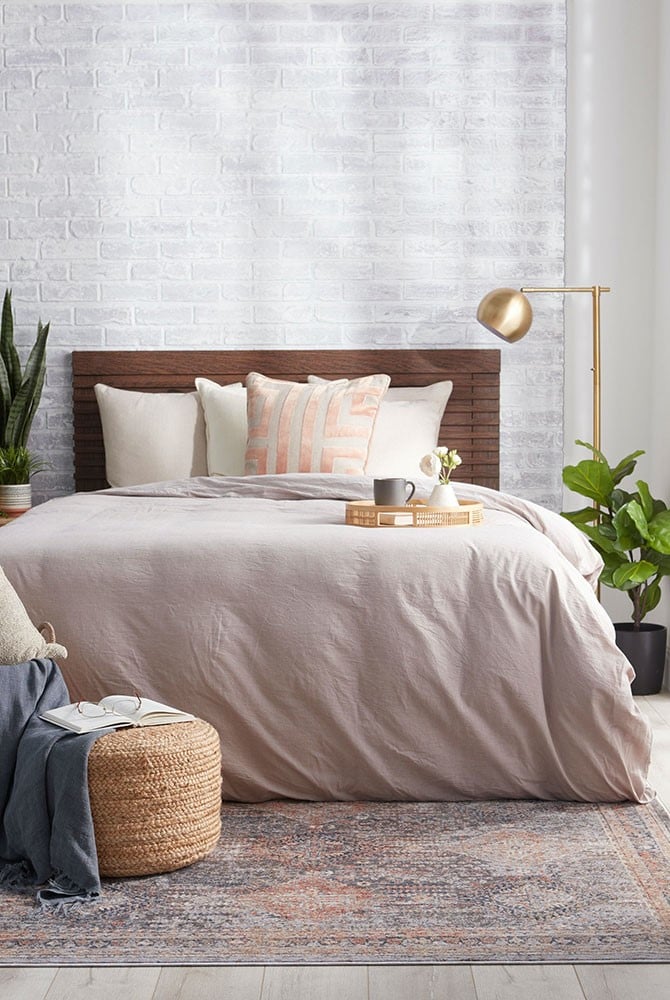
Bedrooms need layered, dimmable warmth. Bathrooms need flattering vanity placement and moisture-rated fixtures. Both reward upgrading far beyond a single overhead fixture.
Great outdoor lighting transforms your home's curb appeal, improves safety, and creates magical entertaining spaces. The key is layering across zones: entry, pathway, landscape, and patio.
Even beautiful rooms get undermined by these overlooked lighting decisions. Here's what to watch for, and how Lightopia's guides help you avoid them.
| Common Mistake | The Problem | The Fix |
|---|---|---|
| Fixture Too Small | Looks undersized and doesn’t provide enough light | Use room dimensions to calculate proper fixture size |
| Pendants Hung Too High | Reduces both function and visual connection | Hang 30–36" above countertops or surfaces |
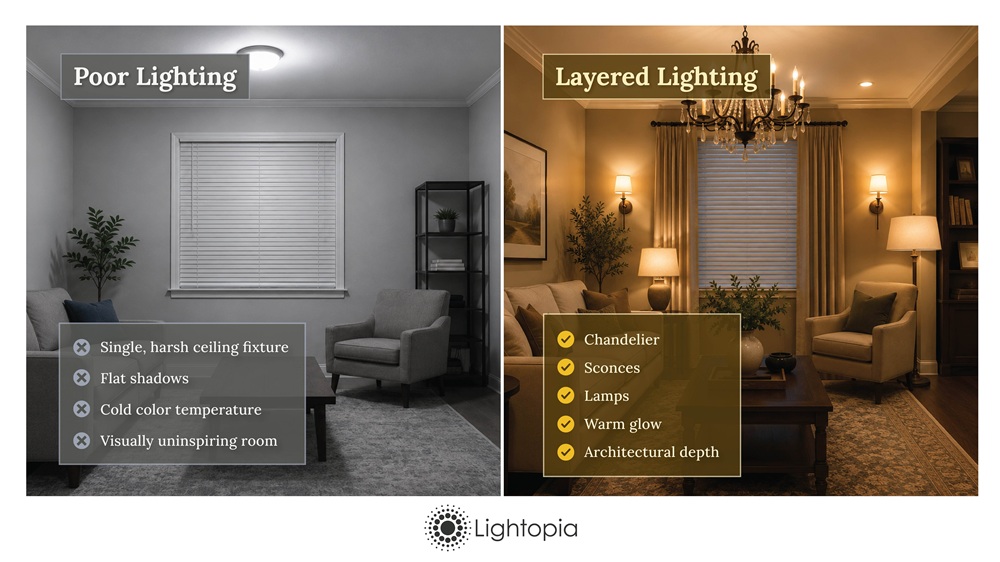
| Single Overhead Fixture Only | Creates flat, harsh lighting | Layer ambient, task, and accent lighting |
| Ignoring Dimmers | Limits control over mood and energy use | Add dimmers to as many circuits as possible |
| Wrong Color Temperature | Feels too cold or too warm for the space | Use 2700–3000K for living areas and 3000–3500K for task zones |
| Skipping Outdoor Lighting Layers | Leads to dark, unsafe, or uninviting exteriors | Combine pathway, porch, and landscape lighting for full coverage |
Start with the three layers of lighting: ambient (general illumination), task (focused work light), and accent (decorative atmosphere). Choose fixtures that fit your ceiling height and room dimensions, then select bulb temperatures that match how you use each space, warmer tones for living areas, slightly cooler for task-heavy kitchens and bathrooms.
The three foundational types are ambient lighting (general room illumination from chandeliers, flush mounts, or recessed fixtures), task lighting (focused light from under-cabinet strips, vanity fixtures, or reading lamps), and accent lighting (decorative and directional light from sconces, picture lights, or architectural cove lighting). Great rooms use all three.
A well-lit living room combines a statement overhead fixture (chandelier or semi-flush) for ambient light, floor and table lamps for layered warmth, and wall sconces or accent lights to create depth. Avoid relying on a single ceiling fixture, it creates flat, uninviting light that makes the room feel smaller.
A good rule of thumb is a minimum of three light sources in any living space: one ambient source, one task source, and one accent or decorative source. Larger rooms benefit from five or more. More sources give you more control over mood, function, and visual comfort.
For living spaces and bedrooms, 2700K–3000K produces warm, inviting light similar to incandescent bulbs. Kitchens and bathrooms benefit from 3000K–3500K, which is warm but slightly brighter for task visibility. Avoid 4000K+ in residential spaces unless you specifically need a clinical, daylight-style environment.
Yes, modern LED bulbs are the best choice for nearly every residential application. They use 75–80% less energy than incandescent bulbs, last significantly longer, and are available in a full range of color temperatures. Make sure to choose dimmable LED bulbs if your fixtures are on dimmer switches, as not all LEDs are dimmer-compatible.
THANK YOU!
Your discount code is on its way.
If you don't receive your promo code, please check your email junk or spam folder and click on "Not spam".
Free Shipping
Free standard shipping on all orders within the contiguous USA.
Orders to Canada, Alaska, Hawaii and Puerto Rico will incur additional shipping and handling fees, which will be calculated and presented at checkout. Canadian customers will be charged for all applicable customs duties, taxes, and brokerage fees.
For large, oversize items that require a surcharge above our shipping and freight partners’ standard shipping rates, an Oversize Processing Fee will be calculated in cart.