


The dining room chandelier is the most important single fixture purchase in most homes. It defines the room’s entire aesthetic, sets the mood for every meal, and creates the visual focal point your eye lands on from the moment you enter the space.
Get it right and it transforms ordinary dinners into moments. Get it wrong and even a beautifully furnished room feels unfinished. The three decisions that matter most: size, height, and shape.
The most common dining room lighting mistake is choosing a fixture that’s too small. Err toward the larger end of any sizing formula, an oversized chandelier creates drama. An undersized one creates disappointment.
Add your dining room’s length and width in feet. That number in inches equals your ideal chandelier diameter.
Your chandelier should be 12 inches narrower than your dining table on each side. A 60-inch (5-foot) table calls for a chandelier no wider than 36 inches. This ensures the fixture visually anchors the table without overwhelming it or extending beyond the sightline of seated guests.
Hanging height is as important as size. Too high and the chandelier loses its visual and functional impact. Too low and it becomes an obstacle.
| Ceiling Height | Ideal Chandelier Bottom Height Above Table | Notes |
|---|---|---|
| 8-foot ceiling | 30–34 inches above table surface | Standard; use a semi-flush if room feels tight |
| 9-foot ceiling | 32–36 inches above table surface | Most common dining room scenario |
| 10-foot ceiling | 36–40 inches above table surface | Room for a longer drop — consider a multi-tier chandelier |
| 12+ foot ceiling | 40–48 inches above table surface | Grand scale opportunity; go larger on fixture diameter too |
| Vaulted ceiling | 36–42 inches above table surface | Use an extended downrod; measure to lowest hanging point |
The shape of your dining fixture should relate to the shape of your table and the proportions of your room.
| Fixture Shape | Best Table Match | Best Room Shape | Design Style Fit |
|---|---|---|---|
| Round chandelier | Round or square tables | Square dining rooms | Traditional, transitional, glamorous, sculptural |
| Linear / rectangular | Long rectangular tables | Narrow or galley-style rooms | Modern, contemporary, farmhouse, industrial |
| Oval chandelier | Oval or long rectangular tables | Proportional rectangular rooms | Traditional, transitional, eclectic |
| Multi-pendant cluster | Any table shape | Open-concept dining areas | Modern, bohemian, organic contemporary |
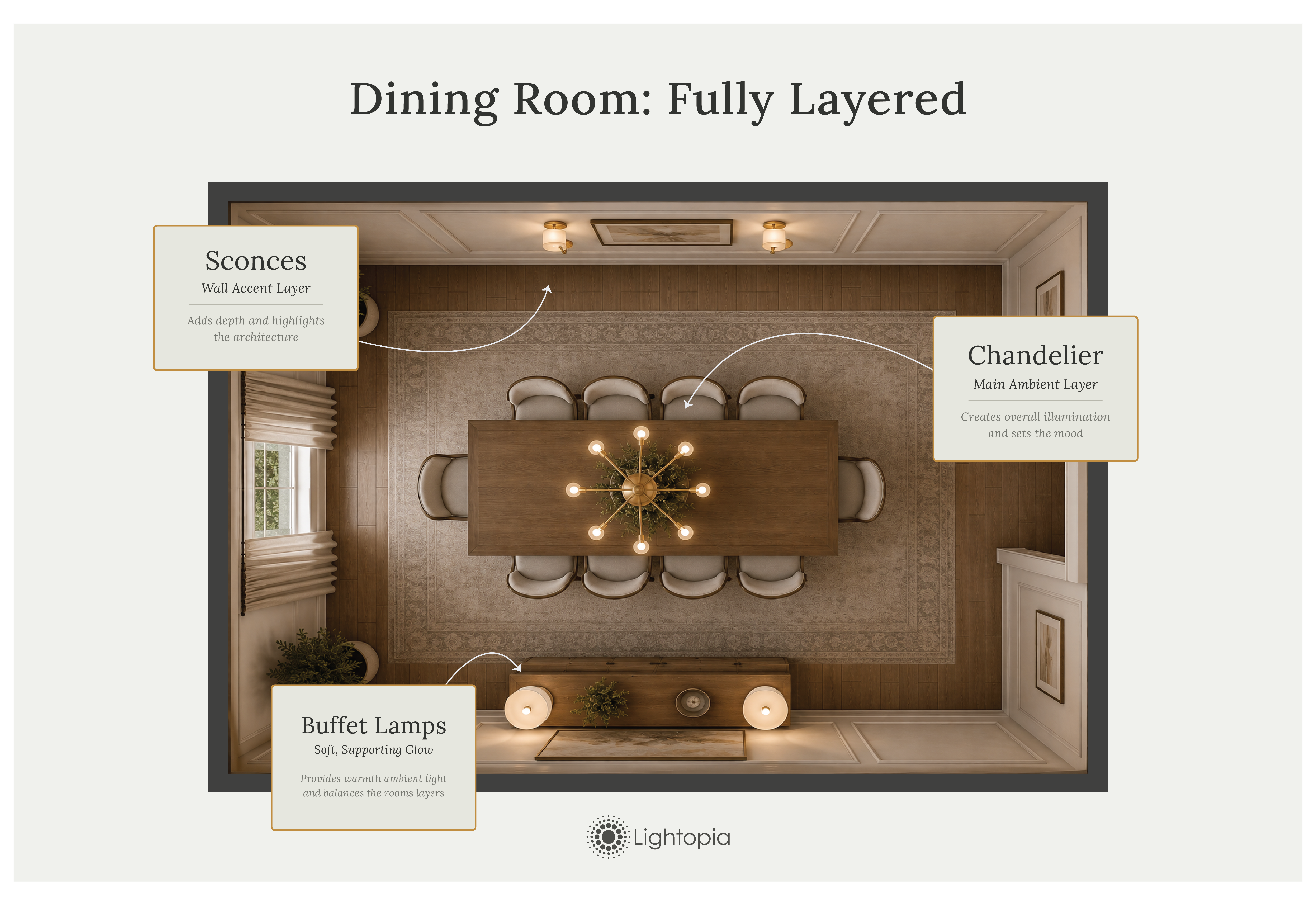
A chandelier alone creates beautiful ambient light for the table. But a truly great dining room has additional layers that add depth and flexibility.
Flanking sconces on the dining room walls add warmth to the perimeter and reduce the contrast between the bright table and darker walls. They also allow you to dim the chandelier without losing all room illumination.
A table lamp or pair of lamps on a buffet adds a secondary warm light source at a different height. This is particularly effective in formal dining rooms where a full layered look is desired.
The single most impactful upgrade in any dining room is putting the chandelier on a dimmer. It transforms the entire emotional character of the space from afternoon to evening without changing a single fixture.
Add your room’s length and width in feet, that total in inches is your ideal chandelier diameter. For a 12x14 foot dining room, look for a 24–28 inch chandelier. Always err toward the larger end of the range; undersized chandeliers are the most common dining room lighting mistake.
For standard 8–9 foot ceilings, hang the bottom of the chandelier 30–34 inches above the table surface. For every additional foot of ceiling height above 8 feet, add 3 inches of hanging height. In vaulted or open-concept dining spaces, adjust based on the lowest point of the ceiling directly above the table.
Warm light (2700K–3000K) is ideal for dining rooms. It makes food look beautiful, creates a flattering glow for guests, and generates the relaxed, intimate atmosphere that makes dinners feel special. Avoid cool or daylight-range bulbs in dining spaces.
Yes, pendant clusters or multiple pendants hung in a linear arrangement above a dining table work beautifully and offer a more contemporary alternative to traditional chandeliers. For rectangular tables, two or three coordinating pendants spaced evenly provide both task illumination and design impact.
In open-concept dining areas, define the dining zone with a statement fixture positioned directly over the table, this creates visual separation without a wall. Supplement with recessed lighting in the surrounding space, and consider sconces or a console lamp on a nearby wall to warm the perimeter.
THANK YOU!
Your discount code is on its way.
If you don't receive your promo code, please check your email junk or spam folder and click on "Not spam".
Free Shipping
Free standard shipping on all orders within the contiguous USA.
Orders to Canada, Alaska, Hawaii and Puerto Rico will incur additional shipping and handling fees, which will be calculated and presented at checkout. Canadian customers will be charged for all applicable customs duties, taxes, and brokerage fees.
For large, oversize items that require a surcharge above our shipping and freight partners’ standard shipping rates, an Oversize Processing Fee will be calculated in cart.