

The kitchen is the most functionally demanding room in any home. It’s where you prep ingredients at 6am, cook dinner under time pressure, help kids with homework at the island, and entertain guests over drinks. No other room asks that much of its lighting.
Poor kitchen lighting creates real problems: shadows on cutting boards, eye strain over the sink, flat finishes that look underwhelming, and ambiance that’s more cafeteria than home. The solution isn’t simply brighter lights, it’s the right lights in the right places. Our kitchen specialists see under-lit prep surfaces every week. Here’s how to fix it.
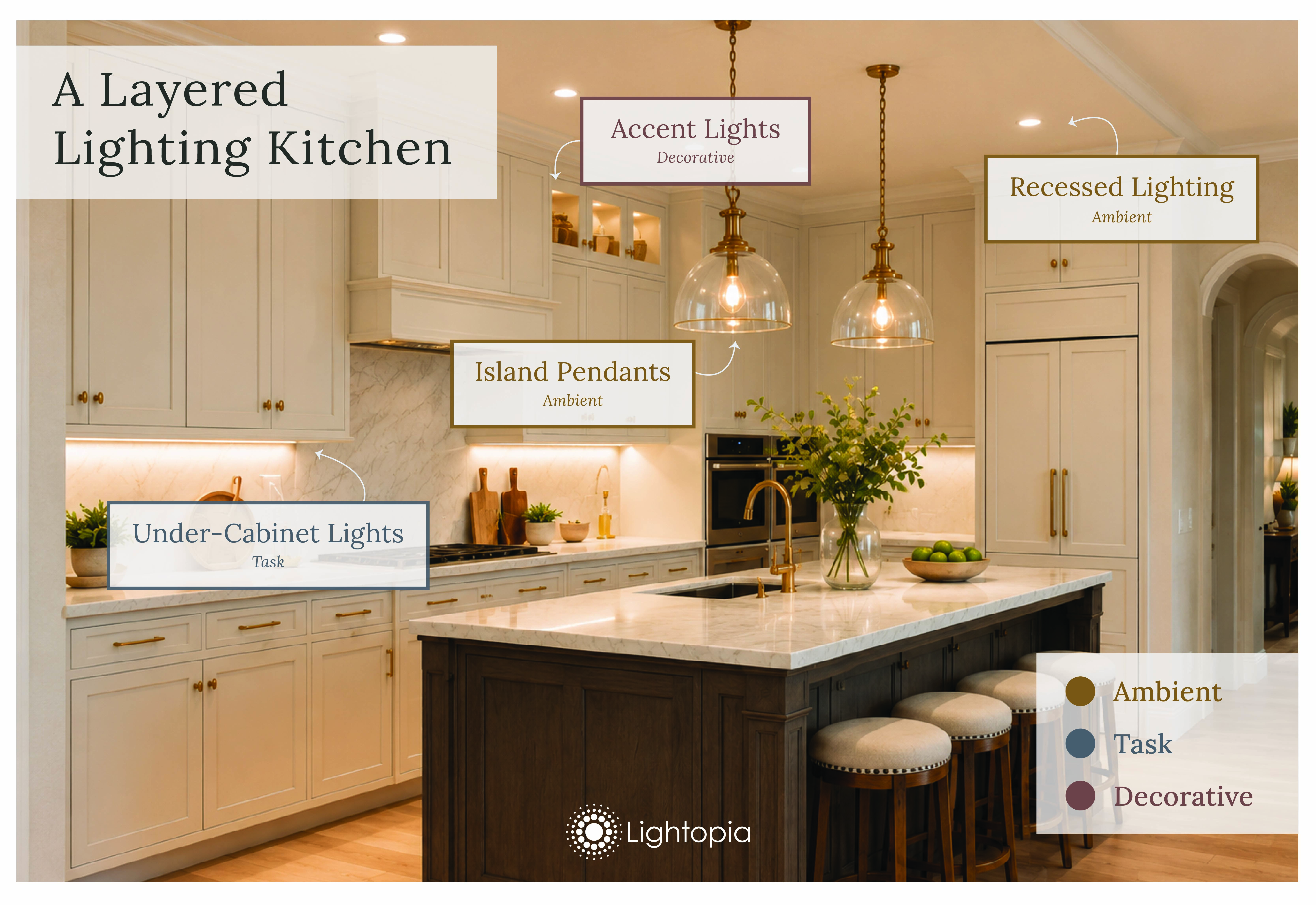
Kitchen ambient lighting provides the foundation of general visibility. Recessed downlights are the most common choice. Space them every 4–6 feet depending on ceiling height, and always put them on a dimmer.
Task lighting eliminates shadows at your most important work surfaces. Under-cabinet strips are the single most impactful kitchen lighting upgrade most homeowners haven’t made. They’re the difference between guessing and seeing clearly.
Decorative kitchen lighting adds personality and defines the room’s style. Statement chandeliers or pendants over the island are the most high-impact design element in most kitchens, they function like jewelry for the space.
Island pendant lighting is the most-searched kitchen lighting topic — and the one with the most confusion. Here’s the complete answer.
| Island Length | Pendant Recommendation | Spacing |
|---|---|---|
| Up to 4 feet | 1 large pendant (16–20" diameter) | Centered |
| 4–6 feet | 2 pendants (10–14" diameter each) | Equal spacing, 24" from each end |
| 6–8 feet | 3 pendants (8–12" diameter each) | 24" between pendants, 12" from ends |
| 8+ feet | 3 large pendants or linear multi-light | Even distribution across full length |
The standard hanging height for kitchen island pendants is 30–36 inches above the countertop surface. This positions the light source at the optimal task height while keeping the visual sightline clear across the island. For taller ceilings (9+ feet), you can add 3 inches of height per additional foot of ceiling.
Pendant diameter should be roughly one-third the width of your island. A 36-inch wide island suits 10–14 inch pendants. If using a single statement pendant, go larger, up to half the island width, for proper visual proportion.

Under-cabinet lighting is the most functional kitchen upgrade available, and one of the most misunderstood categories. Here’s how to choose confidently.
| Type | Best For | Key Consideration |
|---|---|---|
| LED strip lights | Long countertop runs, seamless glow | Choose a warm CCT (2700–3000K) |
| LED puck lights | Targeted task zones, easy install | Space evenly to avoid hot spots |
| LED bar lights | Mid-length cabinets, clean look | Measure cabinet depth for fit |
| Hardwired fixtures | Permanent installations, cleanest result | Recommend electrician installation |
| Plug-in options | Renter-friendly, no electrical work | Manage cord visibility with clips or channels |
Color temperature has a bigger impact on how your kitchen feels than almost any other lighting decision. Here’s the breakdown:
| Kelvin Range | Light Character | Best Kitchen Use |
|---|---|---|
| 2700K | Very warm, amber-toned, cozy | Dining nooks, decorative pendants, open-concept connection to living areas |
| 3000K | Warm white, balanced — most popular | General kitchen ambient, under-cabinet task lighting |
| 3500K | Slightly cool white, crisp | Task-heavy prep zones, professional-style kitchens |
| 4000K+ | Neutral to cool daylight | Studio kitchens, commercial-style spaces — rarely ideal in residential |
| Mistake | The Problem | The Fix |
|---|---|---|
| Pendants hung too high | Loses task function, looks disconnected | 30–36" above countertop, always |
| Poor pendant spacing | Uneven light, visually awkward | Follow the spacing formula for your island size |
| Skipping task lighting | Dark prep surfaces, safety risk | Under-cabinet strips at every counter zone |
| Too-cool bulb temperature | Clinical, harsh kitchen feel | Stay at 2700–3000K for residential warmth |
| No dimmer on pendants | Overpowering during evening use | Dimmer-compatible pendants + bulbs always |
Use one pendant for islands up to 4 feet, two pendants for 4–6 foot islands, and three pendants for 6–8 foot islands. Space them evenly with approximately 24 inches between each fixture and 12 inches from the ends of the island.
3000K is the most versatile choice for most kitchens, warm enough to feel residential, bright enough for accurate task visibility. Use 2700K for decorative pendants or dining nook fixtures, and 3500K if you have a very task-intensive professional-style kitchen.
Kitchens benefit from warm-to-neutral lighting in the 2700K–3000K range for ambient and decorative fixtures. Avoid anything above 3500K in standard residential kitchens, it creates a clinical feel that’s uncomfortable for everyday living.
LED strip lights are the most popular choice for under-cabinet lighting because they provide seamless, even illumination across the full counter length. Choose a warm white (2700–3000K), dimmable strip and install it at the front of the cabinet for optimal task coverage.
For multiple pendants over a kitchen island, space them 24–30 inches apart from center to center. Keep the outer pendants at least 6–12 inches from the end of the island. Smaller pendants (8–10 inch diameter) can be spaced slightly closer; larger fixtures need more breathing room.
THANK YOU!
Your discount code is on its way.
If you don't receive your promo code, please check your email junk or spam folder and click on "Not spam".
Free Shipping
Free standard shipping on all orders within the contiguous USA.
Orders to Canada, Alaska, Hawaii and Puerto Rico will incur additional shipping and handling fees, which will be calculated and presented at checkout. Canadian customers will be charged for all applicable customs duties, taxes, and brokerage fees.
For large, oversize items that require a surcharge above our shipping and freight partners’ standard shipping rates, an Oversize Processing Fee will be calculated in cart.