

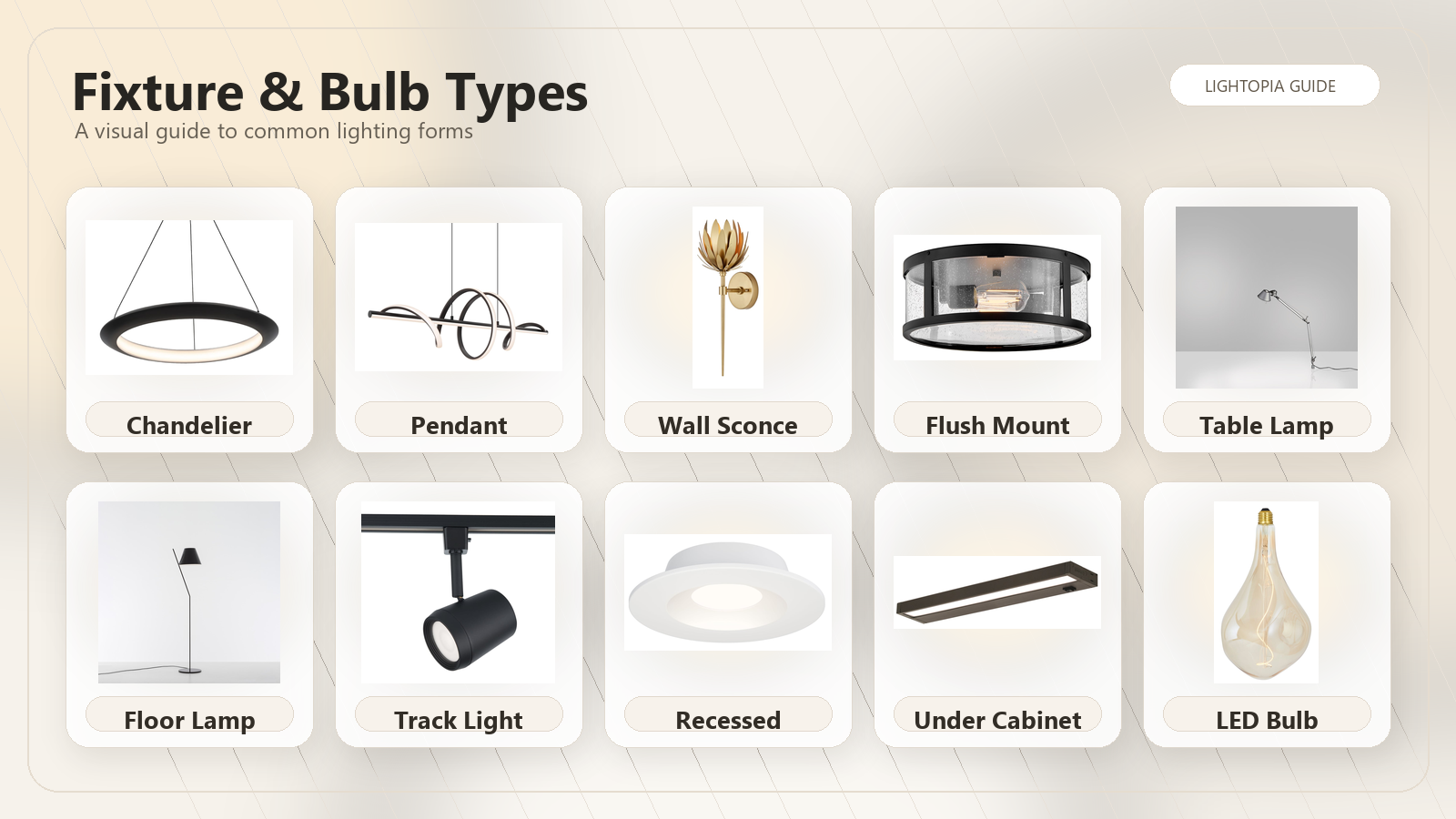
| Fixture Type | What It Is | Best Rooms | Ceiling Requirement |
|---|---|---|---|
| Chandelier | Decorative hanging fixture, often multi-arm or multi-light | Dining, foyer, living room, bedroom | 9'+ ideal; 8' minimum with shorter drop |
| Pendant | Single hanging fixture on cord, chain, or rod | Kitchen, bar, foyer, bedroom | 8'+ recommended |
| Semi-Flush Mount | Fixture that drops 4–8 inches from ceiling | Bedroom, hallway, office | 8'+ ceilings |
| Flush Mount | Sits flat against the ceiling | Any room with lower ceilings | 8' and under |
| Recessed Light | Installed inside ceiling, no visible housing | Any room, especially kitchens and hallways | Standard ceiling (requires attic or crawl space access) |
| Wall Sconce | Mounted to wall, horizontal light source | Hallways, bathrooms, bedrooms, living rooms | None (wall-mounted) |
| Table Lamp | Portable fixture with shade, sits on surface | Living rooms, bedrooms, offices | None (portable) |
| Floor Lamp | Tall freestanding portable fixture | Living rooms, reading corners | None (portable) |
| Track Lighting | Multiple adjustable heads on a single track | Kitchens, galleries, retail-style spaces | Standard ceiling |
| Vanity Light | Horizontal bar above or beside bathroom mirror | Bathrooms | None (wall-mounted) |
| Picture Light | Small fixture mounted above artwork | Living rooms, dining rooms, hallways | None (wall-mounted) |
| Under-Cabinet Light | Mounted under upper cabinets for task lighting | Kitchens, workshops, laundry rooms | None (cabinet-mounted) |
Watts measure energy consumption. Lumens measure light output. When shopping for bulbs, lumens are the number that matters.
Since LED bulbs use dramatically less energy than incandescent bulbs to produce the same brightness, wattage is a poor guide to light output. A 10-watt LED produces the same approximately 800 lumens as a 60-watt incandescent.
| Lumens (Brightness) | Old Incandescent Equivalent | Modern LED Wattage |
|---|---|---|
| 450 lumens | 40 watts | ~6 watts LED |
| 800 lumens | 60 watts | ~10 watts LED |
| 1,100 lumens | 75 watts | ~14 watts LED |
| 1,600 lumens | 100 watts | ~19 watts LED |
| 2,600 lumens | 150 watts | ~30 watts LED |
| Room | Recommended Total Lumens | Notes |
|---|---|---|
| Kitchen | 5,000–10,000 lumens total | Higher end for task-heavy kitchens, lower for open-concept |
| Living Room | 1,500–3,000 lumens | Spread across multiple fixtures; use dimmers |
| Dining Room | 3,000–6,000 lumens | Chandelier + supplementary sources |
| Bedroom | 1,000–2,000 lumens | Prioritize layering over raw brightness |
| Bathroom | 4,000–8,000 lumens | Higher for makeup vanity; 1,600 lumens minimum per sink |
| Hallway | 500–1,000 lumens | Functional navigation lighting |
| Home Office | 3,000–6,000 lumens | Task-heavy; combine ambient and desk task light |

Color temperature is measured in Kelvin (K). Lower numbers are warmer (more amber); higher numbers are cooler (more blue-white). This is one of the most important, and most misunderstood, lighting decisions homeowners make.
| Kelvin Range | Light Color Description | Best Applications | Avoid In |
|---|---|---|---|
| 2200–2700K | Very warm amber-white, like candlelight or vintage incandescent | Living rooms, bedrooms, dining rooms, romantic or intimate spaces | Kitchens, home offices, task-heavy areas |
| 2700–3000K | Warm white — the residential standard and most popular range | Most rooms: living, dining, bedroom, general bathroom | Rarely inappropriate in residential settings |
| 3000–3500K | Neutral warm white, slightly crisper | Kitchens, bathrooms with grooming needs, home offices | Bedrooms if sleep-sensitive |
| 3500–4000K | Neutral white, clear and bright | Garages, laundry, utility spaces, commercial-inspired kitchens | Living rooms, dining rooms, bedrooms |
| 4000K+ | Cool daylight, blue-white tone | Commercial, industrial, specialty task lighting | Almost all residential spaces |
| Bulb Type | Efficiency | Lifespan | Best Use | Key Consideration |
|---|---|---|---|---|
| LED | Most efficient (75–80% less than incandescent) | 15,000–50,000 hours | Universal — every residential application | Choose dimmable; check dimmer compatibility |
| CFL (Compact Fluorescent) | Good (75% less than incandescent) | 8,000–15,000 hours | High-use areas, utility rooms | Slow warm-up, contains mercury — handle carefully |
| Halogen | Moderate (25–30% less than incandescent) | 2,000–4,000 hours | Accent lighting, display lighting | Runs very hot; being phased out |
| Incandescent | Least efficient | 1,000–2,000 hours | Legacy fixtures (being phased out) | No longer manufactured in most wattages |
| Smart LED | Most efficient + programmable | 25,000–50,000 hours | Whole-home smart systems | Requires compatible dimmer or hub |
Dimmers are one of the highest-impact, lowest-cost lighting upgrades you can make. But not all dimmers work with all bulbs. Here’s how to avoid compatibility issues.
When these occur, the fix is almost always either replacing the bulb with a dimmable LED or replacing the dimmer with an LED-compatible model.
Smart lighting systems allow you to control color temperature, brightness, and scheduling via smartphone, voice assistant, or automation routines. They’re a meaningful upgrade for high-use rooms and whole-home systems.

Watts measure how much energy a bulb consumes. Lumens measure how much light it produces. With LED bulbs now universal, shopping by watts is outdated. A 10-watt LED produces approximately 800 lumens, the same brightness as an old 60-watt incandescent bulb. Always shop by lumens when choosing bulbs.
For most residential spaces, 2700K–3000K is the ideal range. It’s warm enough to feel residential and comfortable, bright enough for everyday tasks. Use 2700K for living rooms and bedrooms where relaxation is the priority. Use 3000K–3500K for kitchens, bathrooms, and home offices where task clarity matters more.
Yes — LED bulbs are the best choice for virtually every residential application. They use 75–80% less energy than incandescent bulbs, last 15–50 times longer, produce no UV or infrared heat, and are available across every color temperature and lumen range. Make sure to choose dimmable LED bulbs for fixtures on dimmer circuits.
Non-dimmable LED bulbs on a dimmer circuit will typically flicker, buzz, or behave erratically at low dim levels. In some cases they’ll work fine at full brightness but fail when dimmed. Always choose bulbs labeled “dimmable” for any fixture on a dimmer circuit, and pair them with a dimmer specifically rated for LED loads.
THANK YOU!
Your discount code is on its way.
If you don't receive your promo code, please check your email junk or spam folder and click on "Not spam".
Free Shipping
Free standard shipping on all orders within the contiguous USA.
Orders to Canada, Alaska, Hawaii and Puerto Rico will incur additional shipping and handling fees, which will be calculated and presented at checkout. Canadian customers will be charged for all applicable customs duties, taxes, and brokerage fees.
For large, oversize items that require a surcharge above our shipping and freight partners’ standard shipping rates, an Oversize Processing Fee will be calculated in cart.