

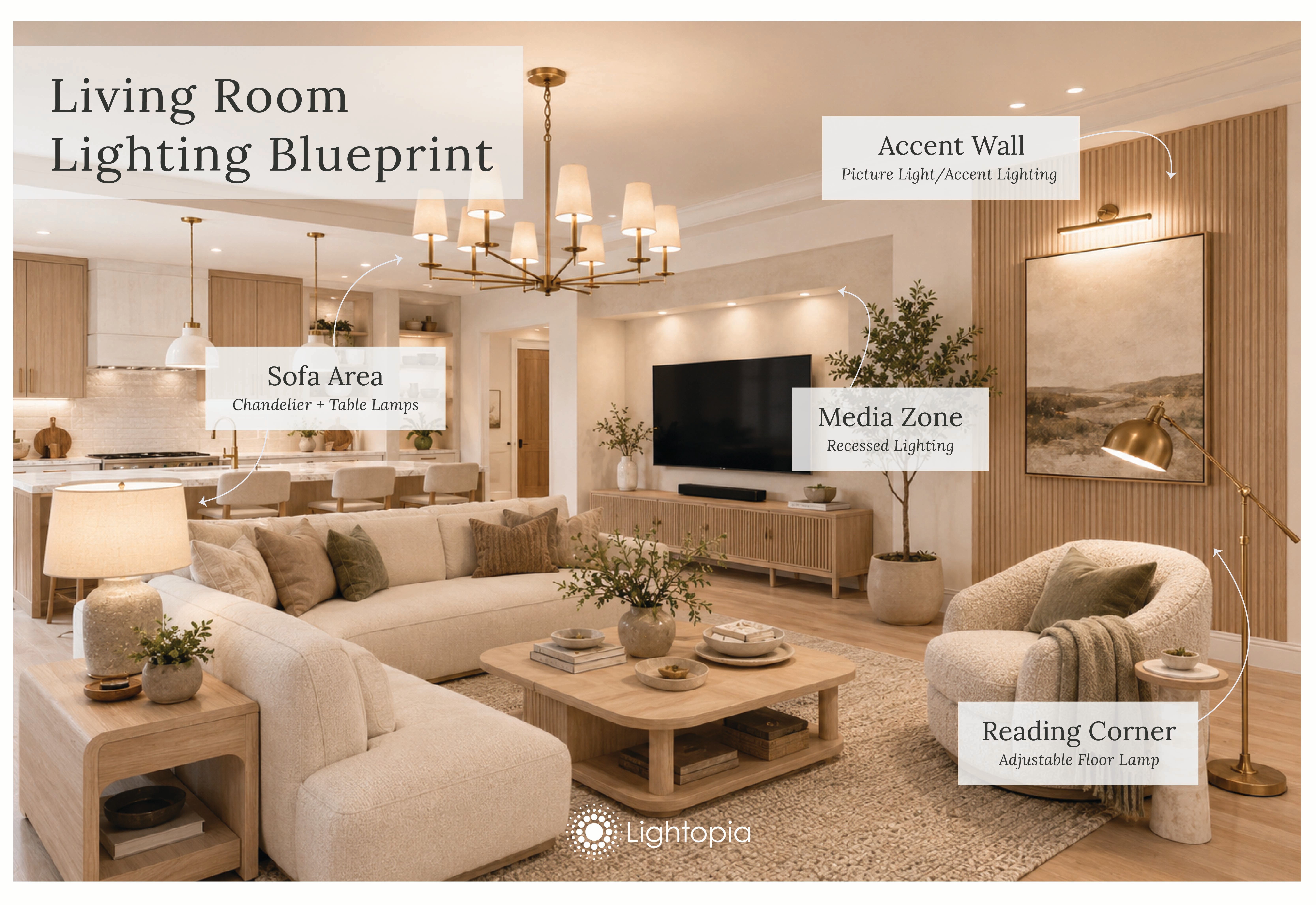
The living room is where your household gathers, entertains, relaxes, and transitions through every mood across the day. Single-source lighting, typically one ceiling fixture, is the most common mistake homeowners make in this space.
A properly layered living room uses multiple fixture types at different heights and intensities to create a space that feels warm in the evening, bright enough for reading, and dramatic enough to impress. The good news: it doesn’t require a complete renovation. Strategic lamp placement and a few well-chosen fixtures go a long way.
Lighting is the single most transformative element in any room, and the most overlooked. After helping thousands of homeowners find their perfect fixtures (and reading every one of your #mylightopia reviews), we've seen firsthand: the right fixtures don't just illuminate a space. They shape how it feels, how large it looks, and how much time you want to spend in it.
Here's what great lighting actually does for your home:

Great living room lighting starts with a plan before you shop. Identify your activity zones and design one lighting layer for each.
| Zone | Primary Need | Recommended Fixture |
|---|---|---|
| Seating / sofa area | Ambient warmth + conversation light | Chandelier or semi-flush above, table lamps nearby |
| Reading corner | Focused task light at seated eye level | Floor lamp with adjustable arm or swing-arm sconce |
| Media / TV wall | Low-glare ambient fill | Recessed lighting or floor lamps behind the TV |
| Accent wall / fireplace | Dramatic focal highlight | Sconces, picture lights, or directional recessed |
| Entryway connection | Transitional warmth and welcome | Table lamp or sconce near entry threshold |
Never rely on a single overhead fixture. Even a beautiful chandelier, used alone, creates flat, unflattering light and deep shadows. Add floor lamps, table lamps, and sconces to build the multiple light levels that make a room feel designed rather than simply lit.
The living room chandelier sets the design tone of the entire space. In formal living rooms, a large-scale chandelier creates drama and sophistication. In casual spaces, an oversized pendant or a sculptural flush mount achieves the same visual impact at lower ceilings.
Sizing rule: Add your room’s length and width in feet. That number in inches is your ideal chandelier diameter. A 15' x 18' room calls for a 33" chandelier.
Floor lamps are the most flexible layering tool in any living room. Position them behind sofas or chairs to cast warm uplight behind the seating area, or beside reading chairs for focused task illumination. Arched floor lamps over sofas are particularly effective in open-concept spaces where overhead fixtures may be misaligned with furniture groupings.
Table lamps on side tables, consoles, or shelving add warm pools of light at seated eye level, the most flattering and comfortable height for evening living. Use pairs of matching lamps to anchor a sofa or media console symmetrically.
Sconces provide both functional ambient light and beautiful decorative accent. Flanking a fireplace, framing an artwork, or lining a hallway connection all work beautifully. Plug-in sconces with cord covers offer a hardwired look without electrical work.
Recessed lights provide clean ambient fill without visual clutter. They’re ideal in contemporary or minimalist living rooms where decorative fixture quantity needs to stay low. Space recessed lights every 4–6 feet and always put them on dimmers.
In compact spaces, choose lighting that adds height and openness. A single pendant or semi-flush mount with high-efficiency bulbs keeps the ceiling visually clear. Tall floor lamps draw the eye upward. Mirrors positioned near light sources dramatically amplify the effect.
Open layouts require lighting that defines zones visually without walls. Use a statement overhead fixture to anchor the seating area, recessed lighting in the transition zone toward the kitchen, and floor lamps at the perimeter to warm the edges.
Formal spaces support higher investment in decorative fixtures. A chandelier is expected here. Pair it with flanking wall sconces, table lamps on matching end tables, and picture or artwork lighting to complete the luxurious, layered look.
Reduce screen glare and eye strain with lighting positioned behind the TV rather than in front of it. Bias lighting (an LED strip behind the television) is one of the most effective and affordable upgrades. Keep overhead lighting low and indirect.
| Mistake | Why It Hurts | The Fix |
|---|---|---|
| Too few light sources | Flat, clinical feel with harsh shadows | Minimum 3 light sources in any living room |
| Poor scale | Fixture looks lost or overwhelms the space | Use the room dimension formula for sizing |
| Harsh cool lighting | Feels like an office, not a home | Stay at 2700K–3000K for warm residential feel |
| No dimmers | No flexibility for mood or time of day | Put every circuit on a dimmer switch |
| Lamps too close together | Uneven pools of light, visual clutter | Space lamps across the room at different heights |
The best living room lighting combines three layers: an ambient source (chandelier, semi-flush, or recessed lights), task lighting (floor lamp or table lamps near seating), and accent lighting (sconces or decorative lamps). This creates comfortable, versatile light that works for everyday living, entertaining, and relaxing.
For general living room illumination, aim for 1,500–3,000 total lumens depending on room size. A 15x20 foot living room typically needs 2,000–3,000 lumens across all fixtures combined. Always put lights on dimmers so you can adjust brightness for different activities and times of day.
Warm light (2700K–3000K) is ideal for living rooms. It creates the cozy, residential feel that makes a space comfortable for relaxing and entertaining. Cool light (4000K+) tends to feel harsh and institutional in living spaces.
A standard living room benefits from at least 2–3 table or floor lamps in addition to the overhead fixture. Larger rooms can comfortably accommodate 4–5 lamps at different heights. The goal is eliminating dark corners while creating warm, layered pools of light rather than uniform brightness.
THANK YOU!
Your discount code is on its way.
If you don't receive your promo code, please check your email junk or spam folder and click on "Not spam".
Free Shipping
Free standard shipping on all orders within the contiguous USA.
Orders to Canada, Alaska, Hawaii and Puerto Rico will incur additional shipping and handling fees, which will be calculated and presented at checkout. Canadian customers will be charged for all applicable customs duties, taxes, and brokerage fees.
For large, oversize items that require a surcharge above our shipping and freight partners’ standard shipping rates, an Oversize Processing Fee will be calculated in cart.