

Bathroom lighting must satisfy three distinct requirements simultaneously: flattering illumination for grooming, practical task visibility, and compliance with moisture safety codes. Poor vanity placement creates unflattering shadows. Under-lit mirrors make grooming harder. And the wrong fixture rating in a wet zone is a safety hazard. This guide covers everything you need to choose confidently.
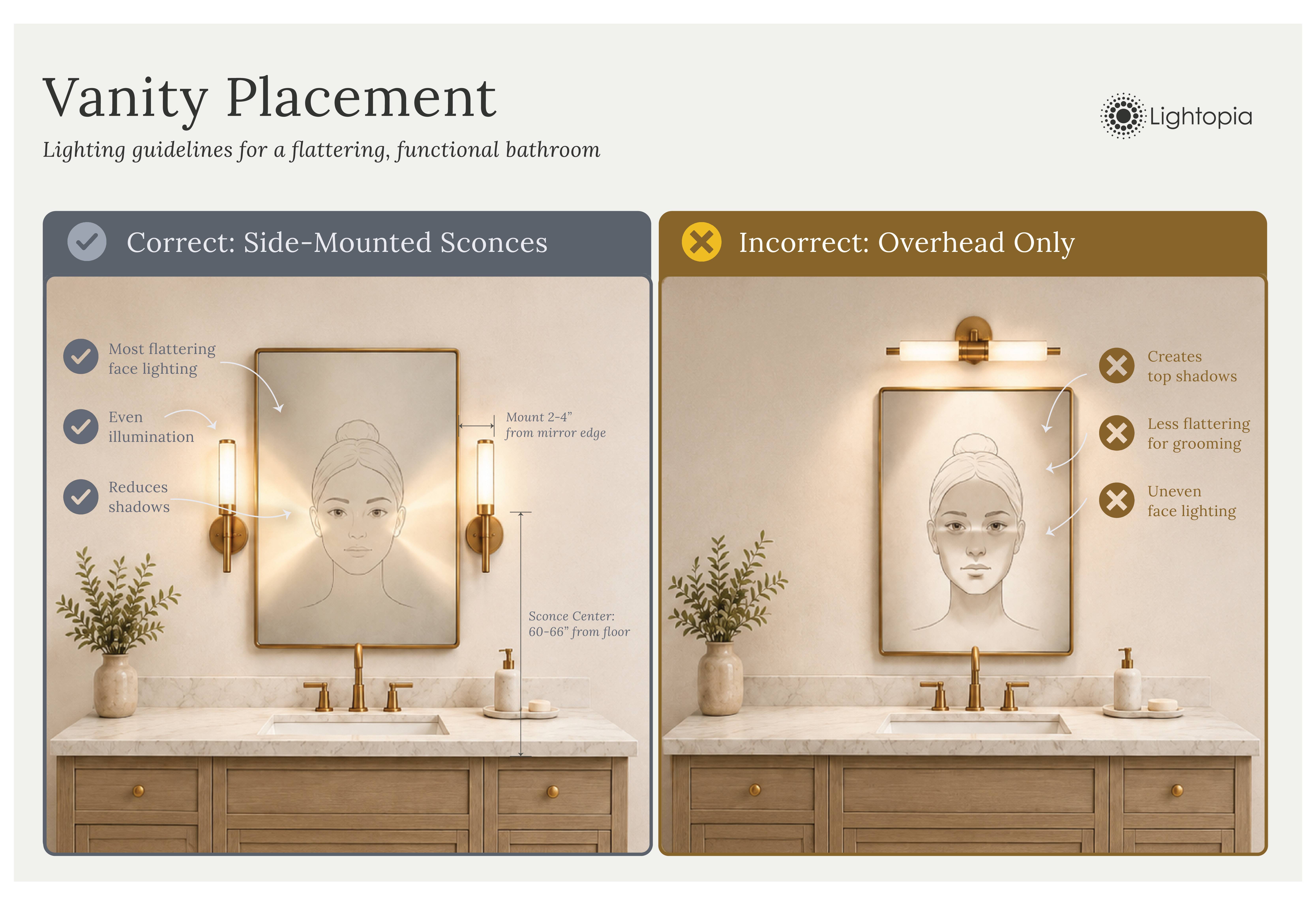
The vanity is the focal point of bathroom lighting design. Placement errors here create shadows that make the face harder to see and unflattering to look at.
Side-mounted sconces at eye level (approximately 60–65 inches from the floor to fixture center) eliminate the unflattering top-shadow created by overhead-only vanity bars. Flanking the mirror on both sides produces the most even, flattering face illumination possible.
A vanity bar mounted above the mirror works well when side mounting isn’t possible. For best results, use a bar that extends at least to the edges of the mirror, or beyond. A too-short bar creates harsh center shadows.
| Vanity Type | Best Setup | Mounting Height | Bar Width |
|---|---|---|---|
| Single-sink vanity | Side sconces (pair) | 60–65" from floor | N/A — flank mirror |
| Double-sink vanity | Overhead bar or 2 side sconces | Top of mirror for bar | Equal to or wider than mirror |
| Powder room | Single overhead or one sconce | 60–65" for sconce | Match mirror width |
| Master bath / spa vanity | Side sconces + overhead bar | 60–65" for sconces | Wider than mirror for bar |
Moisture ratings aren’t optional in bathrooms, they’re a safety and building code requirement. Here’s what each rating means and where each applies.
| Rating | What It Means | Where It Applies |
|---|---|---|
| Dry Rated | Standard indoor fixture, no moisture resistance | Bedroom, living room, hallway — never in bathrooms |
| Damp Rated | Resists moisture and humidity, not direct water contact | General bathroom area outside the shower zone, covered outdoor areas |
| Wet Rated | Withstands direct water exposure | Inside shower enclosure, directly above bathtubs, outdoor exposed locations |

| Kelvin | Light Character | Best Bathroom Use | Avoid For |
|---|---|---|---|
| 2700K | Very warm, amber-toned | Powder rooms, guest baths, relaxed routines | Precision makeup tasks |
| 3000K | Warm white, balanced | Most bathrooms — general vanity, ambient | N/A — most versatile |
| 3500K | Slightly cool white, crisp | Master baths, makeup-focused vanities | Relaxation-focused spaces |
| 4000K+ | Cool daylight | Commercial / clinical settings only | All residential bathrooms |
Bathroom lighting requires higher overall lumen output than living spaces because of the precision tasks involved.
| Mistake | The Problem | The Fix |
|---|---|---|
| Vanity bar too short | Center shadows on the face | Match or exceed mirror width |
| Light above mirror only | Top shadows, unflattering for grooming | Add side sconces at 60–65" from floor |
| Wrong moisture rating | Safety hazard, code violation | Damp rated for bathroom area; wet rated in shower |
| Cool-tone bulbs (4000K+) | Harsh, clinical feel at the vanity | Stay at 2700–3000K for flattering light |
| Low CRI bulbs | Colors look off; inaccurate makeup application | Use 90+ CRI bulbs at the vanity |
Never rely on a single overhead fixture. Even a beautiful chandelier, used alone, creates flat, unflattering light and deep shadows. Add floor lamps, table lamps, and sconces to build the multiple light levels that make a room feel designed rather than simply lit.
Side-mounted sconces at approximately 60–65 inches from the floor are the most flattering vanity lighting choice. They illuminate the face evenly from both sides, eliminating the harsh top-shadow created by overhead-only bars. Use warm bulbs (2700–3000K) with a high CRI rating (90+) for the most accurate and flattering skin-tone rendering.
Most bathrooms perform best with warm-to-neutral light in the 2700K–3000K range. This provides enough clarity for grooming tasks while remaining flattering rather than harsh. Avoid 4000K+ bathroom lighting unless you’re designing a very modern or clinical-aesthetic space.
A damp-rated fixture is designed to withstand moisture and humidity without direct water contact. In bathrooms, fixtures outside the shower zone typically require damp-rated fixtures at minimum. Only wet-rated fixtures should be installed inside showers or directly above bathtubs, where direct water exposure is possible.
The rule of thumb is 1,600 lumens per sink vanity area. For a double-sink vanity, aim for 3,200 lumens or more at the mirror. Supplement a single overhead bar with side-mounted sconces to ensure even, shadow-free illumination across the face.
Only in certain zones. Fixtures in the general bathroom area require at minimum a damp-rated fixture. Standard dry-rated fixtures should never be installed in any bathroom zone. Only wet-rated fixtures are safe inside showers or directly above bathtubs. Always check UL listings before installing.

THANK YOU!
Your discount code is on its way.
If you don't receive your promo code, please check your email junk or spam folder and click on "Not spam".
Free Shipping
Free standard shipping on all orders within the contiguous USA.
Orders to Canada, Alaska, Hawaii and Puerto Rico will incur additional shipping and handling fees, which will be calculated and presented at checkout. Canadian customers will be charged for all applicable customs duties, taxes, and brokerage fees.
For large, oversize items that require a surcharge above our shipping and freight partners’ standard shipping rates, an Oversize Processing Fee will be calculated in cart.